Drum size is the last question, not the first. Four things decide which machine fits a site — and three of them rule models out before cubic metres ever come into it. Here is the order we use, with the numbers behind each step.
Ask on WhatsAppBuyers usually start with cubic metres and work backwards. It is the wrong direction, because the three constraints that eliminate machines are physical and cannot be negotiated:
Answer those four in order and the shortlist usually falls to one or two machines. Answer them out of order and you end up choosing between machines that were never suitable.
This is the one measurement worth going out with a tape for. Not the average road — the gate, the culvert, the bridge parapet, the gap between the wall and the tree. Chassis widths across our range, in ascending order:
| Model | Chassis width | Overall length | What it gets through |
|---|---|---|---|
| LM-S2600 | 2,850 mm | 6,650 mm | Village lanes, walled plots, and the tightest turns on the range |
| LM-A3500 | 2,900 mm | 7,500 mm | 3.5 m³ output in a body narrower than any other 3.5 |
| LM-F3500 | 3,000 mm | 8,020 mm | Open sites, canal banks, long straight runs |
| LM-A4500 | 3,100 mm | 7,930 mm | Haul roads and access tracks built for a truck |
| LM-S3500 / LM-S4000 | 3,130 mm | 7,550 / 7,790 mm | Widest on the range — check every gate first |
Two hundred millimetres does not sound like much. It is the difference between a machine that reaches the pour and a machine that stops at the entrance and discharges into wheelbarrows for the rest of the project — which is a cost that never appears in any quotation.
Note the trap in the middle of that table: the narrowest 3.5 m³ machine is not the one with the smallest drum, it is the LM-A3500, at 2,900 mm. If your site suits a 3.5 but the road does not suit 3.13 m, that is the model the constraint points at.
Cycle time is the only number that turns a drum size into money. Take a 3.5 m³ machine and hold everything else constant — one operator, aggregate stacked at the loading point, a ten-hour shift at 90% utilisation, and an average of 20 km/h on the haul road:
| One-way haul | Cycle time | Batches per shift | Placed per 10 h |
|---|---|---|---|
| 1 km | 16 min | 33 | about 115 m³ |
| 3 km | 28 min | 19 | about 65 m³ |
| 5 km | 40 min | 13 | about 47 m³ |
| 10 km | 70 min | 8 | about 27 m³ |
Read the last row again: the same machine, the same drum, one fifth of the output. Nothing broke and nobody made a mistake — the road simply took the money.
This is why a bigger drum is not automatically the answer to a long haul. Going from 3.5 to 4.5 m³ adds 29% per batch but leaves the 70-minute cycle intact; on a 10 km haul it turns 27 m³ into 35 m³, and a second 3.5 m³ machine on the same road turns it into 54. When the haul is the constraint, the number of units beats the size of the drum. When the haul is short, the opposite is true.
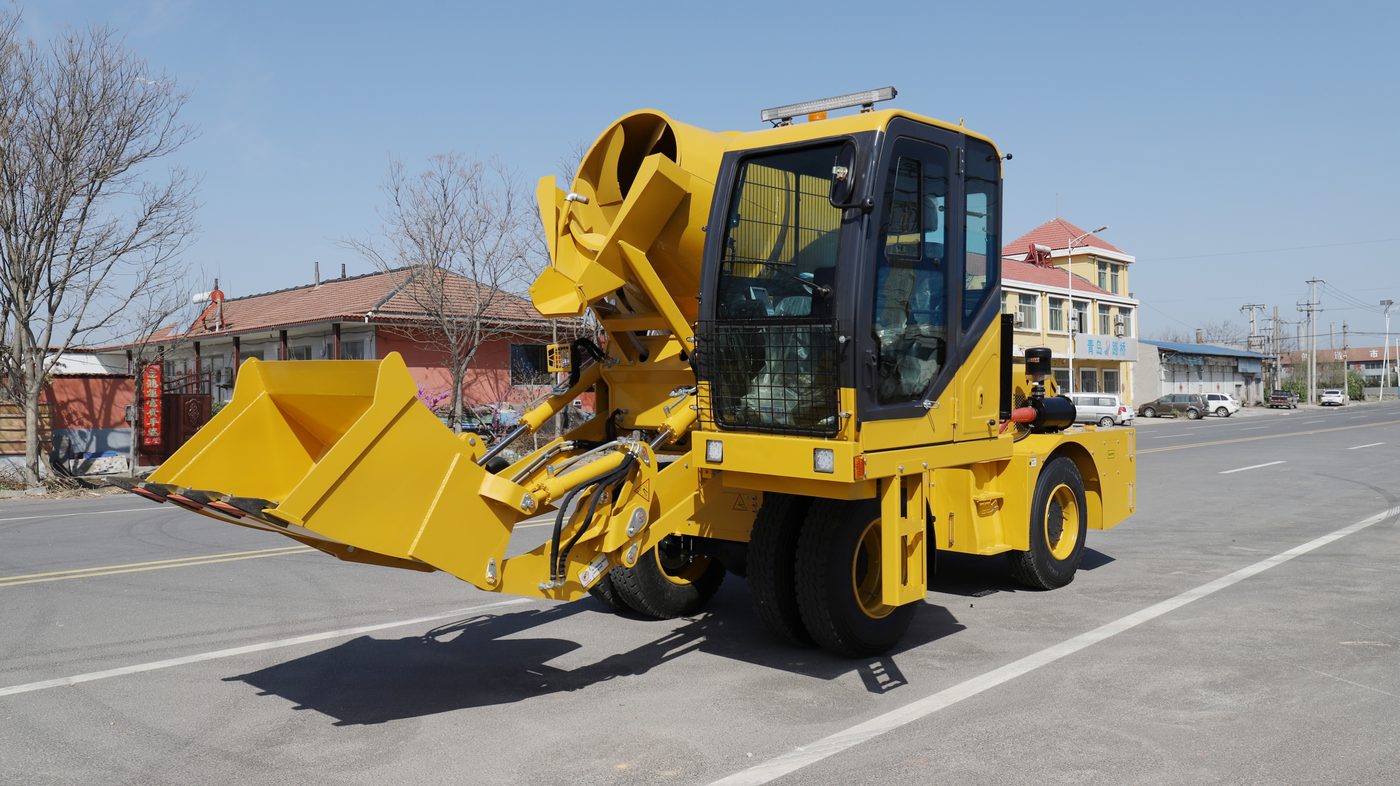
Loading is the cheap part of the cycle. Everything between the stockpile and the formwork is what the clock charges for.
Discharge height across the range is 2,000 to 2,350 mm, and the difference decides which pours a machine can serve without help:
| Discharge height | Models | What it reaches |
|---|---|---|
| 2,000 mm | LM-S2600 | Trenches, kerbs, low formwork, wheelbarrow loading |
| 2,100 mm | LM-S3500, LM-F3500 | Foundation walls, ground slabs, standard column bases |
| 2,350 mm | LM-S4000, LM-A4500 | Raised formwork, retaining walls, direct loading into a dumper or a second truck |
Also in this question: the drum swing. The S series turns the cab and drum together, so the operator faces the pour and can swing 180° either way for a fan-shaped discharge. The A series and F series swing the drum through 270° from a fixed cab — better for a long linear pour such as a canal lining, where you set the angle once and drive forward at a constant speed.
With the three physical constraints settled, daily volume usually leaves one honest answer. These are the four drum sizes, with what each is actually for:
| Rated batch | Model | Weight | Practical output, short haul | Fits |
|---|---|---|---|---|
| 2.6 m³ | LM-S2600 | 7,000 kg | 80–100 m³ / 10 h | Scattered small pours, narrow lanes, first machine for a small contractor |
| 3.5 m³ | LM-A3500 | 8,800 kg | 110–140 m³ / 10 h | 3.5 output where the road is under 3 m |
| 3.5 m³ | LM-S3500 | 8,200 kg | 110–140 m³ / 10 h | The volume seller: best output per unit of fuel and wage |
| 3.5 m³ | LM-F3500 | 8,200 kg | 110–140 m³ / 10 h | Canal lining and long linear pours; the most stable of the three |
| 4.0 m³ | LM-S4000 | 9,100 kg | 120–160 m³ / 10 h | Road packages and housing estates with a proper access road |
| 4.5 m³ | LM-A4500 | 9,500 kg | 150–190 m³ / 10 h | One continuous site, 3.1 m access, discharge into a second container |
Two notes that the table cannot show. First, the LM-A4500 carries a rated 4.5 m³ but runs 4.0–4.3 m³ as a typical full load, because a drum loaded to the nominal figure on every cycle spills on a rough road; plan its output on 4.2. Second, water capacity matters more than buyers expect: 600 L on the 2.6 m³, 760 L split across two tanks on the LM-A4500, 800 L on the LM-A3500, 900 L on the LM-S3500 and LM-F3500, and 950 L on the 4.0 m³. If your sand arrives wet, or the site has no water point, the smaller tank is a limitation you will feel every day.
| Your project | Model the constraints point at |
|---|---|
| Rural road package, 5–20 km, pours of 30–60 m³ | LM-S3500, or LM-S4000 if the access road is open |
| Housing plots inside a town, gates under 3 m | LM-S2600 |
| Canal or drain lining, one continuous run | LM-F3500 — fixed cab, 270° swing, drive-forward pour |
| 3.5 m³ output but a 2.9 m bridge on the only way in | LM-A3500 |
| Factory slab, single site, 3 months, 150 m³ a day | LM-A4500 |
| Dealer stocking for resale across a region | LM-S2600 + LM-S3500 — the two that cover most enquiries |
If your case is not on this list, it is probably because one of the four answers is missing. Send us the four numbers and the shortlist appears on its own — that is genuinely all the information required, and we would rather ask for it than guess.
Only on a short haul. Output is batches per shift multiplied by batch size, and a long haul cuts the first number faster than a bigger drum lifts the second. On a 10 km haul, a 4.5 m³ machine places about 35 m³ in a shift; two 3.5 m³ machines on the same road place about 54 m³.
The LM-S2600 at 2,850 mm overall width, with a 2.6 m³ batch. If you need 3.5 m³ in a narrow body, the LM-A3500 is 2,900 mm — 230 mm narrower than the LM-S3500, which is often the difference at a gate or a bridge parapet.
No, and this is the most common planning error. A machine on site A cannot pour on site B, and travel between them is unpaid. If two sites are active every day, the second machine pays for itself in output long before it pays for itself in price.
It matters differently. The drum size sets how much you place per cycle; the series sets how the machine behaves on site — the S series turns cab and drum together for visibility, the A series uses a one-piece frame for rough ground and continuous heavy cycles, the F series keeps a fixed cab and a 270° drum swing for long linear pours.
Measure the three tightest points on the route — gate, bridge, and the narrowest gap between buildings or trees — and compare against the chassis width plus 100 mm of margin. If the answer is close, ask for the turning radius and the wheelbase as well; a machine that fits but cannot turn around is still stuck.
Send four numbers — narrowest point on the access road, longest one-way haul, cubic metres per day, and the height you need to discharge at. That is enough to name the model without a conversation. If two models both fit, we will say which one we would buy and why.
Get a recommendation Model comparison
Self-loading mixer, or truck mixer and pump? → Where the money actually goes on a pour, and the volumes where each method wins.
How a self-loading concrete mixer works → The seven steps of one batch, with the cycle times behind the output figures above.
Three quick fields — our sales team replies within 24 hours.