Three machines share one chassis: a loader that fills its own shovel, a drum that keeps the concrete alive on the road, and a truck that delivers it to the pour point. One operator, one engine, no batching plant. Below is one complete batch, from stockpile to discharge, with the numbers behind each step.
Ask on WhatsAppOn a conventional site the concrete passes through three separate machines. A wheel loader moves aggregate to a batching plant, the plant weighs and mixes it, and a truck mixer carries it to the formwork. A self-loading mixer collapses that chain into one vehicle: the loader arm and shovel are mounted on the front of the same chassis that carries the drum.
The mechanics are straightforward. Hydraulic rams lift the loaded shovel above the cab and tip it into a charging hopper at the top of the drum. The drum turns at 14 to 17 rpm, so mixing continues while the truck drives. At the pour point the drum reverses and the concrete leaves through a chute that sits 2,000 to 2,350 mm above the ground.
Nothing is weighed. The batch is proportioned by counting buckets and by metering water from an on-board tank — which is how hand batching works anyway, except that here the operator is seated and the shovel is hydraulic.
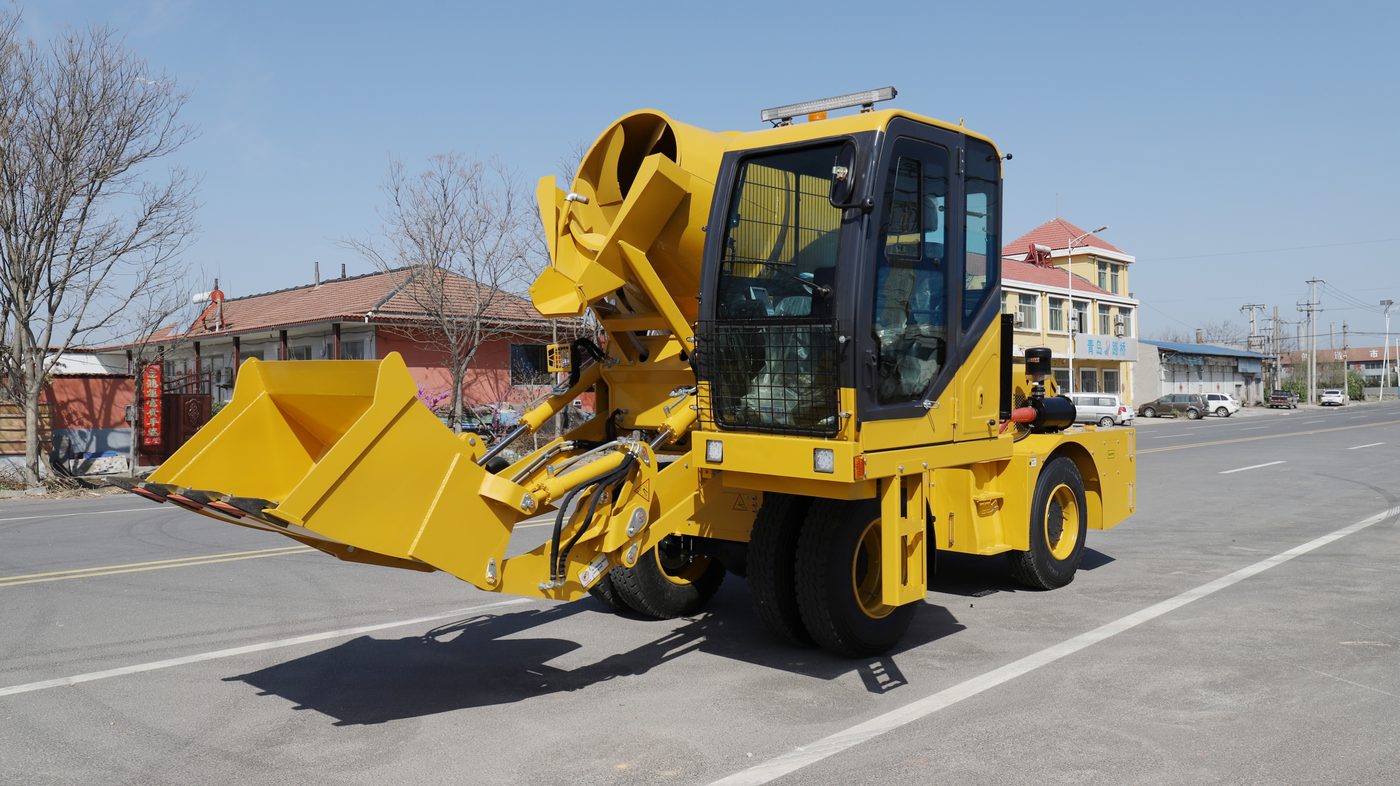
One engine drives the loader, the drum and the wheels. The shovel on the left is the only machine that touches the aggregate pile.
A batch from an empty drum to an empty drum takes about 13 to 16 minutes on a short haul. These are the seven actions inside that time.
The machine drives nose-first to the sand and gravel piles and lowers the shovel. No ramp, no second machine: the pile only has to be reachable by a chassis 2.8 to 3.1 m wide. On most sites the aggregate is dropped by a tipper at the edge of the plot, which is exactly where the mixer starts its cycle.
A full drum needs four to eight buckets of aggregate, depending on the model and the sand-to-gravel ratio. The count is the recipe: the operator keeps the same number for every batch, so the only variable left is moisture, which is trimmed at the water tank.
These counts are worked out from the loader bucket — 0.6 m³ on the 2.6 m³ model, 0.65 m³ on the 3.5 m³, 0.7 m³ on the 4.0 and 4.5 m³ — against the rated batch. The specification sheet gives the bucket volume; the exact count is settled by the operator on the first pour.
The arm raises the bucket over the cab and tips it into the charging hopper. On the synchronized rotary series the cab and drum turn together, so the operator keeps the pile in view while charging instead of twisting in the seat — a small thing that shows up in cycle time after two hundred batches.
Cement goes in by hand, but nobody climbs on the drum. Every machine ships with a cement hopper mounted on the same arm: the crew fills it with the bags before the aggregate run, and it tips into the drum with the last bucket, so cement and aggregate enter in one charge. The water pump is hydraulically driven and a timer relay shuts it off at the set volume, so nobody stands over a valve counting litres. Tanks are 600 L on the 2.6 m³ model, 900 L on the fixed-cab 3.5 m³ and 950 L on the 4.0 m³.
From the first bucket the drum turns at 14 to 17 rpm and keeps turning while the truck drives. Concrete that is mixed in transit does not segregate on a rough haul road, and it does not need to be re-tempered with water at the pour point — the usual reason a delivered load arrives too stiff or too wet.
Top speed is 35 to 45 km/h depending on model. On a village road or a canal bank that is the difference between a 20-minute haul and a 20-minute wait for a delivery that has not left the plant yet.
Reverse the drum and the concrete leaves through the chute at 2,000 to 2,350 mm above ground. That is high enough to fill a foundation trench, a column form or a line of wheelbarrows without a pump, and low enough to control the flow by hand.
A self-loading mixer is not a batching plant and should not be sold as one. There is no load cell on the shovel and no automatic cement scale on the standard machine. Consistency comes from repetition instead: the same bucket, filled the same way, the same number of bags, the same metered water volume, batch after batch.
In practice, a 2.6 m³ batch at a typical 350 kg/m³ cement content takes about 18 bags of 50 kg. An operator who has run the same pile for a week will hold that mix within a workable tolerance all day — which is why these machines dominate rural road, canal and housing work, and why they are rare on structural concrete above C30.
If your specification calls for a tested mix design with a strict water-cement ratio, or the engineer wants a printout per truck, this is the wrong machine. That is an honest limit, not a sales caveat: it is the same limit that makes the machine cheap to run on everything else.
| Model | Rated batch | Buckets per batch (approx.) | Cycle, short haul | Practical output / 10 h |
|---|---|---|---|---|
| LM-S2600 | 2.6 m³ | 4–5 | 13–16 min | 80–100 m³ |
| LM-S3500 | 3.5 m³ | 5–6 | 13–16 min | 110–140 m³ |
| LM-A3500 | 3.5 m³ | 5–6 | 13–16 min | 110–140 m³ |
| LM-S4000 | 4.0 m³ | 5–7 | 13–16 min | 120–160 m³ |
| LM-A4500 | 4.5 m³ | 6–8 | 14–18 min | 150–190 m³ |
The output column assumes a haul under 2 km, one operator, aggregate stacked on site and a ten-hour shift with normal stops. Add 4 to 6 minutes per kilometre of one-way haul and the same machine drops a model size in output — which is why the haul distance, not the drum size, is usually the first question to answer.
| Self-loading mixer | Truck mixer + pump | Batching plant | |
|---|---|---|---|
| Machines on site | 1 | 3 (mixer, pump, loader) | Plant, loader, mixers |
| People | 1 operator | 4–6 | 8 or more |
| Works from | about 30–40 m³ a day | about 100 m³ a day | about 300 m³ a day |
| Setup at a new site | none | 1–2 hours for the pump | 3–7 days |
| Narrow access | 2.8–3.1 m chassis | 6 m plus pump standing area | not movable |
| Best for | Scattered pours, rural roads, canals | High-rise, large single pours | One big site, long duration |
The break-even is not subtle. Below roughly 200 m³ a day, spread across several locations, the fixed cost of a plant and a pump crew is carried by too few cubic metres. Above that, on one site, the plant wins on cost per cubic metre and the mixer becomes a niche tool for the awkward corners. Most of our customers sit in the first group: road packages of 5 to 20 km, housing plots, irrigation channels, factories with a single slab.
Everything else — the 80 to 190 m³ a day, the 3-metre gate, the site with no room for a plant — is where this machine pays for itself in the first season.
Four to eight, depending on the model and the aggregate. The 2.6 m³ drum takes four to five buckets of 0.6 m³; the 3.5 m³ models five to six buckets of 0.65 m³; the 4.0 m³ five to seven; the 4.5 m³ drum six to eight buckets of 0.7 m³. Wet sand needs fewer, dry gravel a few more.
Yes. The drum is driven from the engine and turns at 14 to 17 rpm in transit. That is what keeps the mix homogeneous on a rough haul and removes the need to add water at the pour point.
Not on the standard machine. The batch is proportioned by bucket count, bag count and metered water. If you need weighed batches with a record per load, you need a batching plant — see the limits section above.
Yes. Loading, mixing, travelling and discharging are all controlled from the cab. Most customers run one operator per machine and add a second man on the ground only to guide the chute at the pour point.
Nothing. Thirty minutes with the drum turning is a normal delivery. Beyond roughly 60 to 90 minutes, depending on mix design and ambient temperature, slump loss becomes the constraint — at that point a retarder or a closer aggregate pile is the answer, not a bigger drum.
Tell us three things — the cubic metres you pour in a day, the narrowest road on the way in, and the distance from the aggregate pile to the pour. That is enough to name the model, and to quote it with freight to your port. Every unit ships in one 40-foot high-cube container, dismantled in parts.
Get a quotation Which model fits me?
Self-loading mixer, or truck mixer and pump? → Where the money actually goes on a pour: crew size, set-up, minimum volume, and the five lines nobody quotes.
How to choose a self-loading mixer size → Road width, haul distance, discharge height, then cubic metres — with all six models compared.
Three quick fields — our sales team replies within 24 hours.