Two contractors on the same road package can pay very different prices for the same cubic metre of concrete, and the machine is rarely the reason. What separates them is how many cubic metres each machine places in a day, how many people stand around while it does, and what happens when the pour turns out to be fifteen cubic metres instead of sixty.
Ask on WhatsAppThe cost of placing concrete, as opposed to the cost of buying it, behaves like this:
cost per m³ = (fixed cost of one working day ÷ m³ placed that day) + variable cost per m³
The fixed part is where the two methods diverge. A pump crew has to be mobilised, set up, primed and stood down whether you pour 20 m³ or 200. A self-loading mixer has almost no fixed cost outside its own working day: it drives up, loads, mixes and discharges from the same seat, and if the pour is smaller than expected it simply makes fewer batches.
So the pump's cost per cubic metre is nearly flat and falls slowly, while the mixer's falls steeply as the daily volume rises. Above a certain volume the pump's efficiency wins outright. Below it, the pump crew is being paid to stand next to a pour that is too small to carry them.
One caution before the numbers: if you buy ready-mix instead of batching on site, the delivered price already bundles the plant's buying power and its labour. That is a materials question, not a placing question, and it has to be compared on its own line. Everything below is about placing.
| Self-loading mixer | Truck mixer + pump | |
|---|---|---|
| People on site | 1 operator, plus 1 at the chute | 4–6: driver, pump operator, two or three on the hose |
| Set-up at each pour | None — drive up and discharge | 1–2 hours to position, set outriggers, prime the line |
| Practical output | 80–190 m³ in 10 hours | 150–300 m³ in 10 hours |
| Smallest pour that makes sense | One batch, 2.6–4.5 m³ | Often 30–60 m³ before the mobilisation is worth it |
| Access | Chassis 2.8–3.1 m wide, 35° gradability | 6 m truck plus pump standing area plus a route for the line |
| When the pour is half a load | Batch fewer buckets — nothing is wasted | Part-load premium, or a returned load and a cold joint |
| When the ground is soft | Loaded chassis around 9 tonnes | 26 tonnes plus outriggers — sometimes it cannot reach at all |
| Materials | You buy aggregate and bagged cement yourself | Delivered concrete, priced per m³ with a minimum per truck |
Only two of these rows are about money in the ordinary sense. The rest are about time: the hour spent setting up a pump is an hour of payroll, and a returned load is a day of someone else's schedule.
Strip it to the smallest honest form. Let D be what the self-loading machine costs you per working day — depreciation, maintenance, insurance, finance — and w one operator's daily wage. Let R be the pump crew's day rate including mobilisation and the four or five men on it.
If both were placing the same number of cubic metres, the mixer would be cheaper whenever D + w < R. But they are not placing the same number, so the comparison has to be made at each machine's own output. In practice that means one question: how many cubic metres will this site actually take, per day, for the next three months?
| Daily volume, one site | What dominates the bill | Which method usually wins |
|---|---|---|
| Under 40 m³, spread over several locations | Mobilisation and per-pour fixed cost | Self-loading mixer — one machine, no set-up |
| 40–120 m³, one site, haul under 3 km | Crew size and cycle time | Self-loading mixer; close if the haul is long |
| 120–250 m³, one site | Whether the pump is fully utilised | Depends on the number of pours per week |
| Over 250 m³, continuous | Plant efficiency per m³ | Ready-mix and pump |
The trap in the third row is a pump that is booked for a full day and used for four hours. A pump on standby is the most expensive equipment on any site, because it bills by the day and produces nothing. Contractors who pour three or four times a week often find that a self-loading mixer at two-thirds of the pump's daily output is the cheaper machine, simply because it is never on standby.
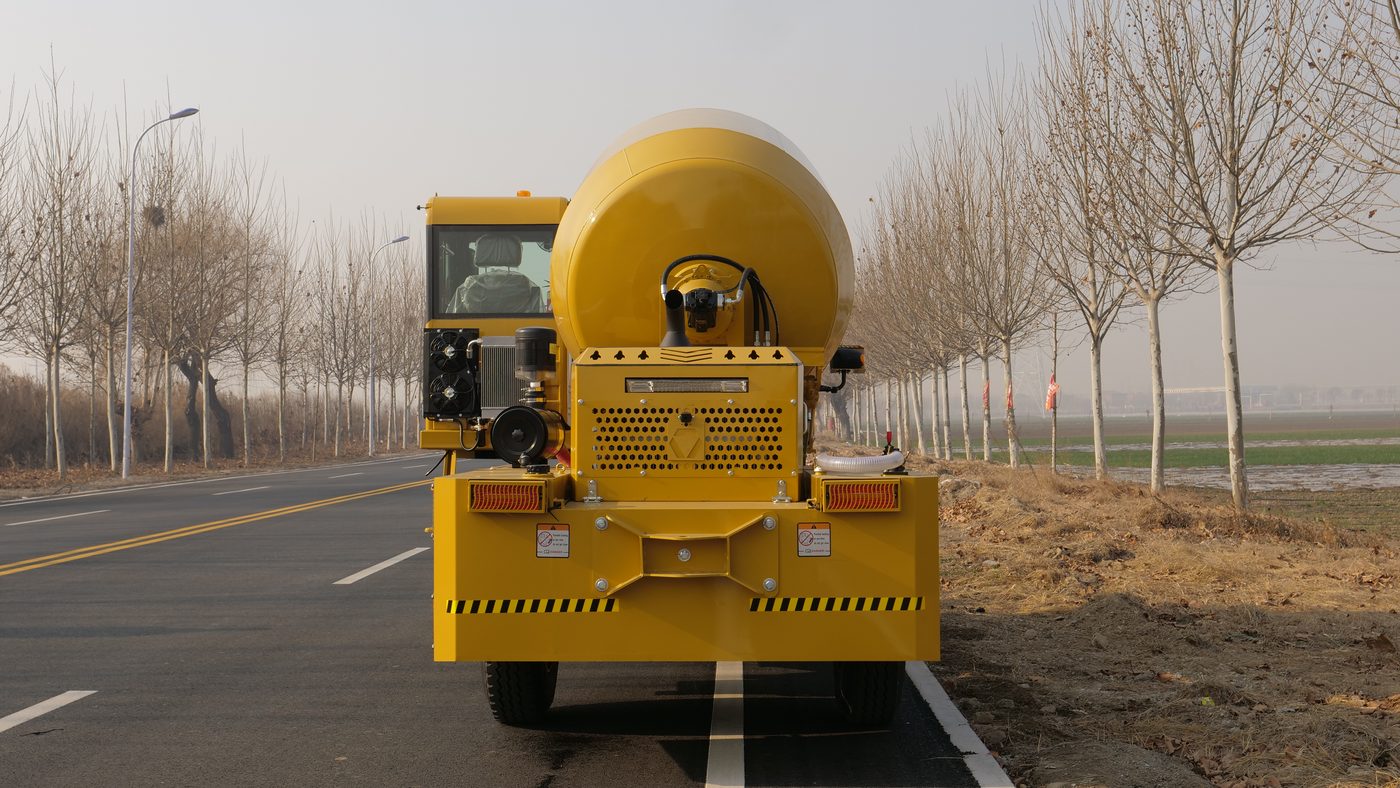
The haul is a cost line, not a detail. Every extra kilometre is four to six minutes of the cycle, and the drum keeps turning while you pay for it.
None of this argues that a pump is a bad machine. It argues that the pump's day rate is only the visible half of the pump's cost, and that comparisons built on the visible half flatter the pump and then disappoint.
Four situations, and they are common enough that we would rather name them than talk around them:
Outside those four, the deciding factor is almost always the number of separate pours per week — not the size of any one of them.
Write these down before you talk to either supplier. Any quotation that cannot be read against all six is not a comparison.
| Question | Why it changes the answer |
|---|---|
| How many m³ per day, on the busiest week? | Sets the fixed cost per m³ for whichever machine you choose |
| How many separate pours per week? | Each pour carries a fixed cost of its own; this is the number that kills pumps |
| What is the longest one-way haul? | 4–6 minutes per kilometre of cycle time, for the mixer |
| What is the narrowest point on the access road? | Decides whether a 6 m truck can reach the pour at all |
| Who supplies cement and aggregate, and at what price? | The materials line, which is separate from placing and often larger |
| What does a day of delay cost you? | The line that never appears in either quote, and usually the biggest one |
If your answers sit in the 30–150 m³ a day range, spread across more than one location, the arithmetic will point at a self-loading machine long before it points at a pump. If they sit above 250 m³ on one site, it will point the other way — and we will tell you so.
Not necessarily, and it depends on what you are comparing. Site-batched concrete avoids the part-load premium, the minimum order and the delivery charge, but you buy cement in bags at retail rather than in bulk. On small and scattered pours the site-batched route usually wins; on one large site with a plant nearby, ready-mix generally wins on materials.
A self-loading mixer needs one operator, plus one man at the chute. A truck mixer with a pump needs four to six: the driver, the pump operator and two or three on the hose. Labour is often the single largest line in the placing cost, which is why this row matters more than the machine price.
It varies with the local pump market, but as a rule of thumb, below 30–60 m³ the mobilisation and the minimum charge dominate, and a pump stops being economical. A self-loading mixer places a single 3.5 m³ batch without any set-up cost at all.
Buy if you will work it more than about 120 days a year and can keep a stockpile within reach of the pour points. Hire if the work is seasonal and concentrated in one place. The crossover is about utilisation, not about the purchase price — an idle machine costs the same per day whether it is owned or rented.
Fuel is a variable cost and it scales with cubic metres, so it rarely decides between the two methods. It does decide between models: a 4.5 m³ drum burns more per hour than a 2.6 m³ one, but it carries more per cycle. Per cubic metre the difference is smaller than most buyers expect.
Send us three numbers — cubic metres per day on your busiest week, the number of separate pours, and the longest haul — and we will tell you which method the arithmetic favours. If that turns out to be a pump and a plant, we will say so; we would rather lose a quotation than sell a machine into the wrong site.
Get a quotation How the machine works
How to choose a self-loading mixer size → Four questions in the right order: road width, haul distance, discharge height, then cubic metres.
Three quick fields — our sales team replies within 24 hours.